
Continuing our series looking at data from our postgraduate research students (check out our previous posts on self-funding and digital capital) we now look at personal outlook. These questions were first added to the survey in 2019, so we have four years’ worth of data, 2019, 2021, 2023 and 2025.
We will talk about the results later, but first some technical points (feel free to skip the next couple of paragraphs if these aren't of interest). While there are five questions in this section of the questionnaire, we have included only four in our scale. In exploring how best to treat these items, we examined a measure of item relatedness that is commonly used to see how questions fit together. This measure, Cronbach’s Alpha, suggested that the five items had a good level of relatedness (0.82), but when one item was deleted, it improved the relatedness of the other four items. The four items that have a Cronbach’s Alpha of 0.85 based on analysis of the 2023 data, are,
- I am satisfied with my life nowadays
- I am satisfied with my life within my institution nowadays
- I am satisfied with my work-life balance
- I feel that my research degree programme is worthwhile
The item not used was, "There is someone in my institution I can talk to about my day-to-day problems."
We have taken the same approach to scoring for the four-item scale as we did with the two previous posts, so have a look there if you want to refresh on this*. We report mean average scores with weighted data.
Results
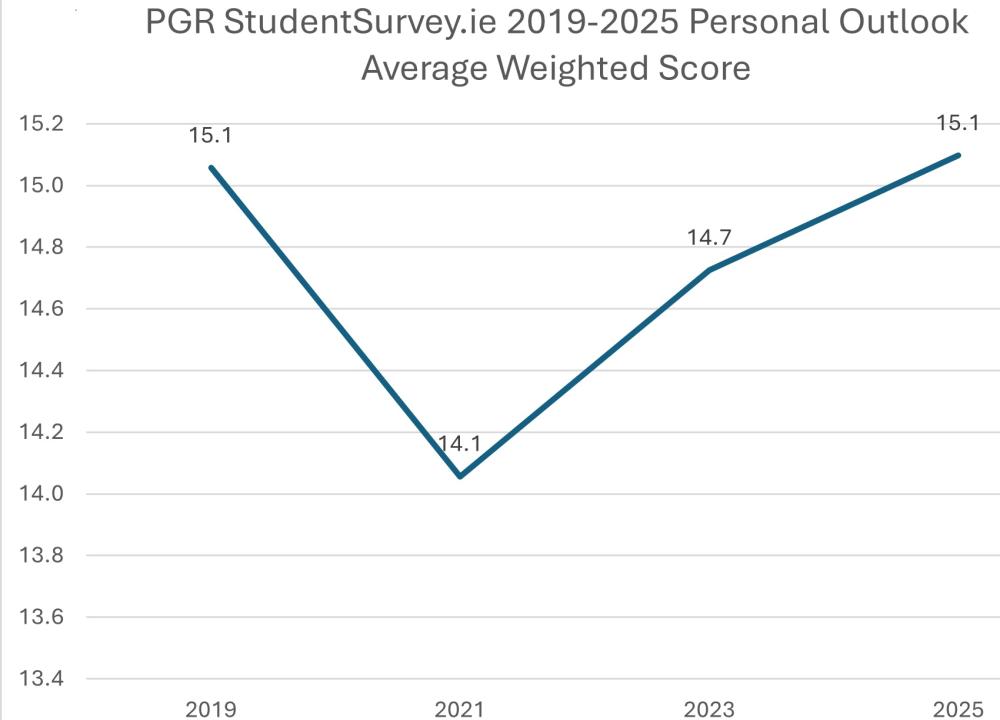
Overall, personal outlook scores in 2025 remain the same as they were in 2019, with a dip visible during the Covid-19 pandemic after which it recovered. It will be interesting to see whether there is more to the current upward trend, and if there will be a further rise in the 2027 data.
Gender
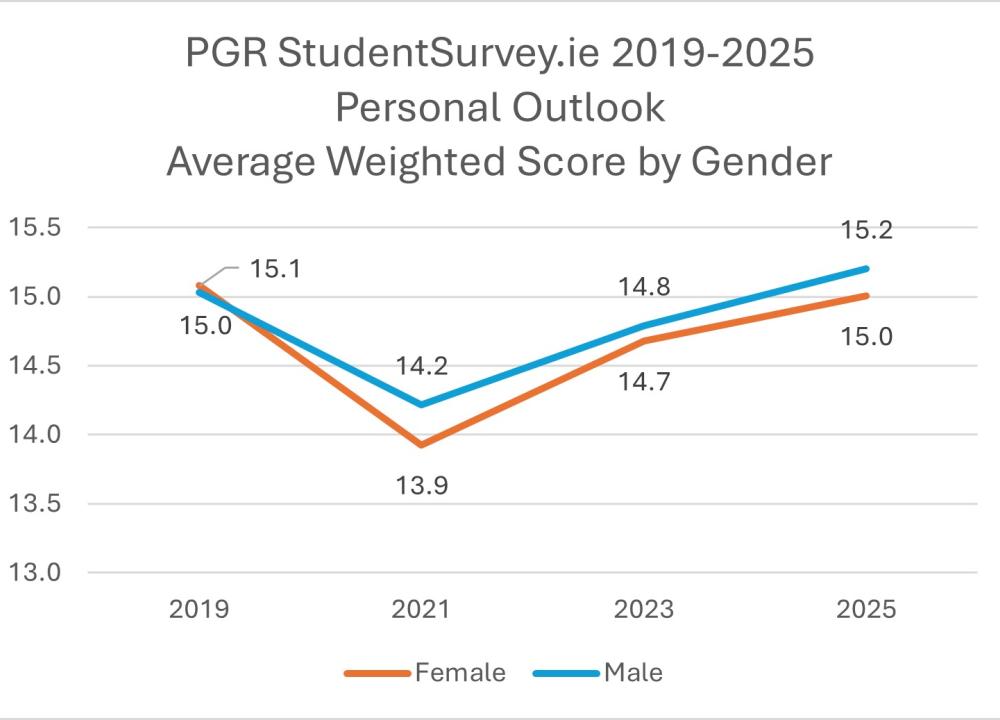
Gender differences are notable; while personal outlook scores were higher for females in 2019, after that time, female respondents reported a less positive overall personal outlook score than males between 2021 and 2025. The gap between females and males was at its widest in 2021, then narrowed in 2023 before widening again in 2025.
Age
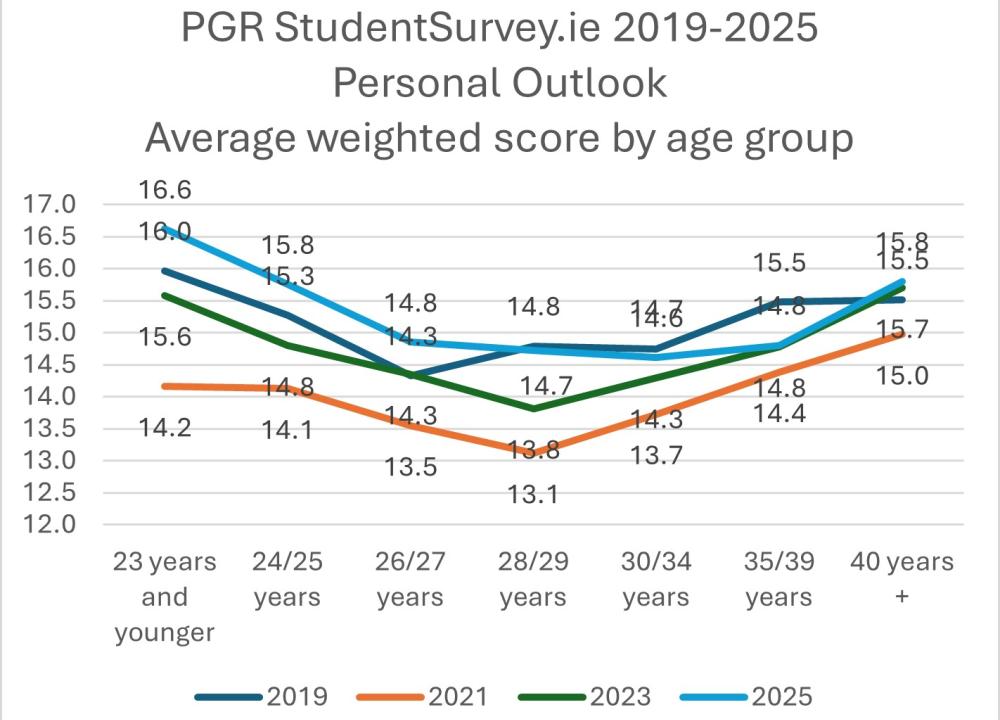
The pattern by age group is broadly similar for each of the four years of data: those under 25 and the 40 plus age group had the highest scores, while those aged 28/29 tended to display the lowest. A clear Covid-19 effect is seen across all age groups in 2021.
Programme type
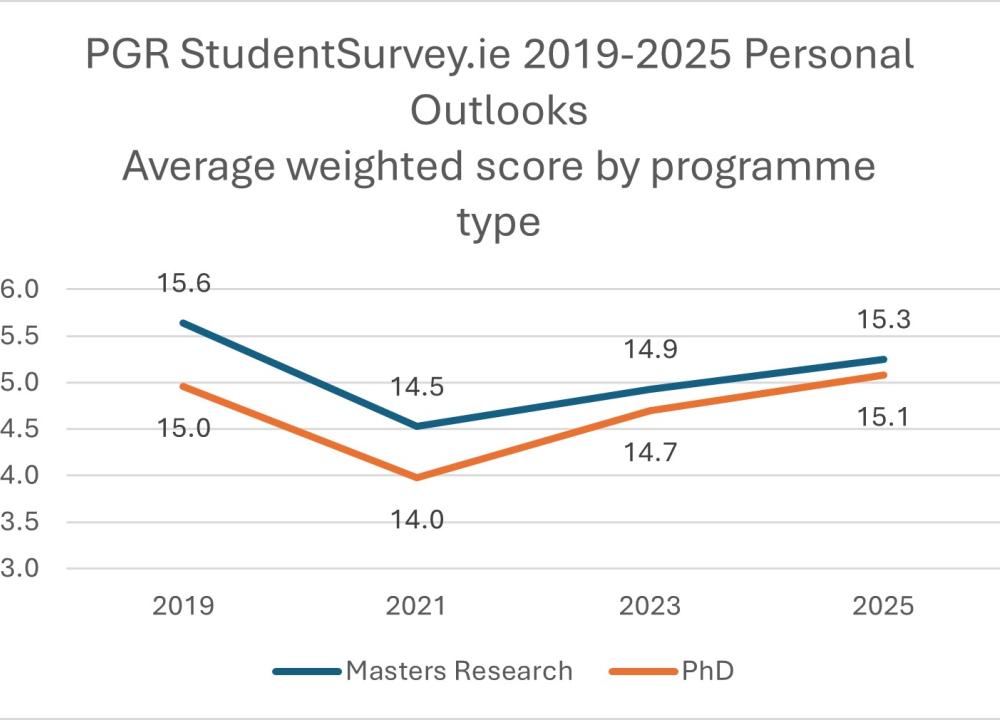
Master’s students tended to have higher personal outlook scores than PhD students, although the gap has narrowed over the period. Only the PhD students had fully returned to or exceed their pre Covid-19 scores (2019) by 2025.
Mode of study
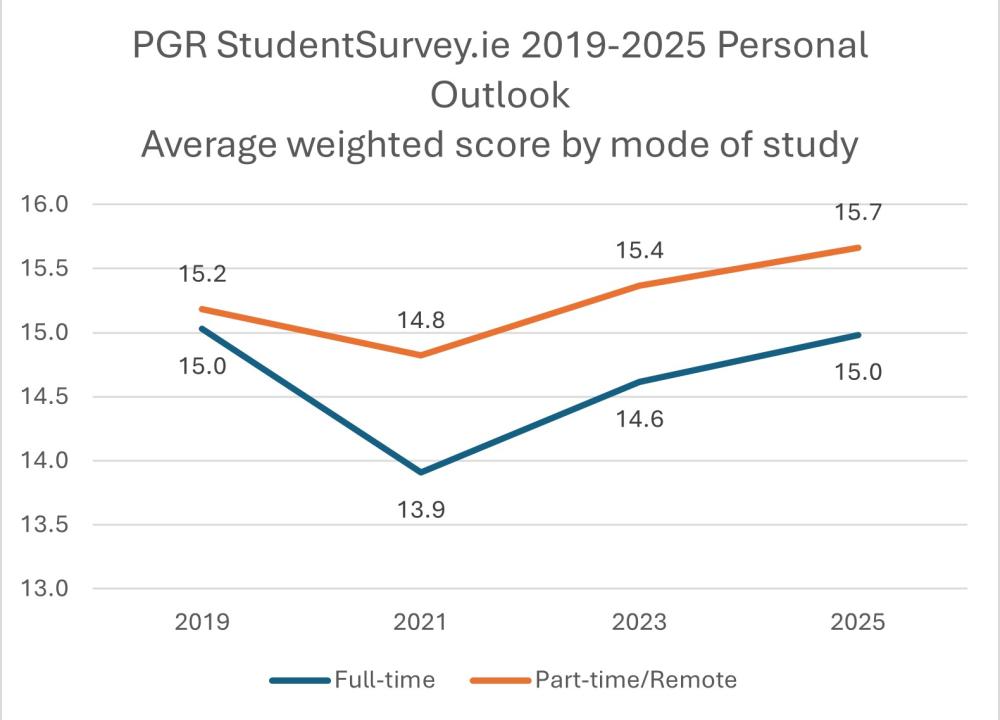
Mode of study shows interesting results. Part-time postgraduate researchers consistently score higher on personal outlook than Full-time learners. One plausible reason for this is that Part-time researchers tend to be older than Full-time researchers (average age 44 vs average age 31), and older researchers tend to have a higher personal outlook score.
Institution type
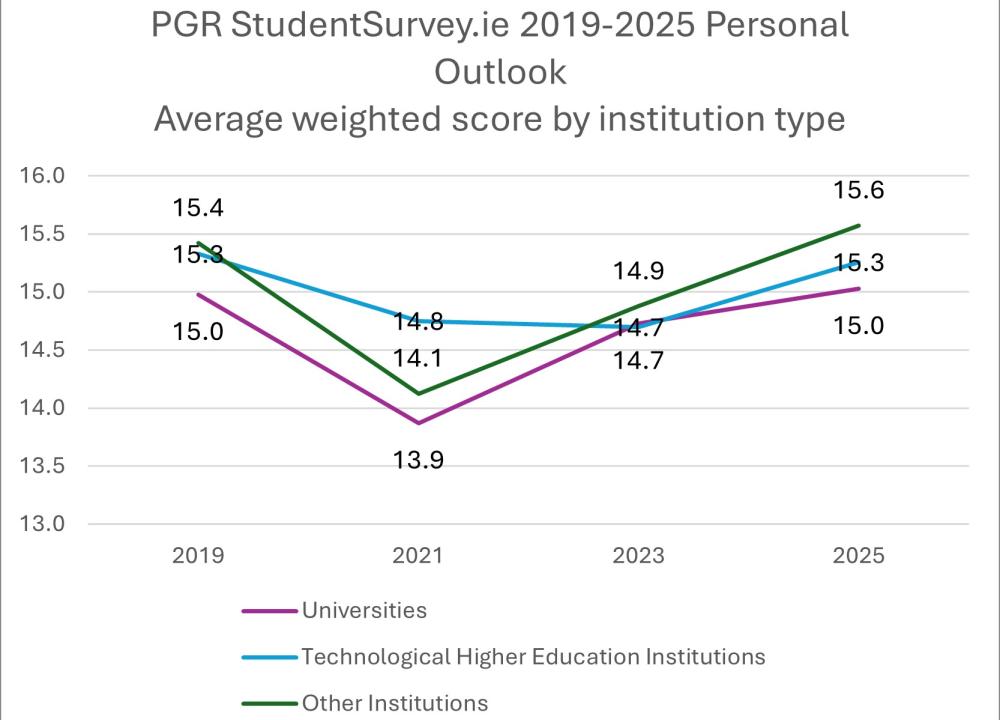
Examining institution type, we see that for almost every year of the survey, Technological Higher Education Institutions, and other Institutions, have shown higher scores on Personal outlook than those of Universities. All institutions also appear to have recovered from the Covid-19 dip visible in 2021. It is interesting that the lower University score also aligns well with PhD scores, which may be related to the fact that Universities have disproportionately more PhD students.
Withdrawal consideration
For students who had seriously considered withdrawal, their personal outlook scores were substantially lower than students who had not seriously considered withdrawing. It is perhaps not surprising that we should see an association between lower valence in outlook measures and a higher likelihood of reporting a measure related to disruptions or challenges to the principal activity in people’s lives, but the difference is quite stark. The question of the causal direction between these two is interesting to consider, or whether other factors are affecting both personal outlook and chances of serious consideration of withdrawal from a research students’ degree.

Overall experience
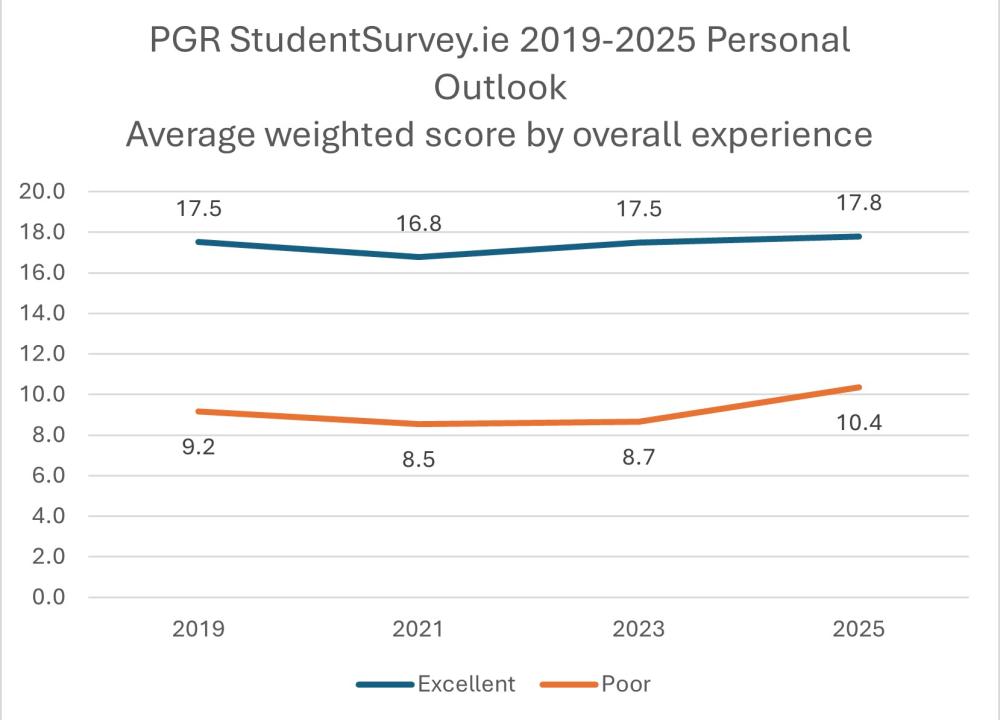
When we looked at outlook by rating of overall experience, we see a very similar strong relationship between students’ contentedness with their college life and their overall outlook.
Summing up this brief analysis of personal outlook scores, some things to ponder. After 2019, overall average weighted scores dipped in 2021 but have since then shown a recovery to 2019 levels again in our latest 2025 survey.
It's worth noting that not all groups we looked at were affected equally. Master’s students tended to have higher personal outlook scores than PhD students. Similarly, Part-time postgraduate researchers consistently score higher on personal outlook than Full-time learners. And for the most part, female respondents scored a less positive overall personal outlook score than males.
The second takeaway is the strong relationship between personal outlook and broad measures of research student sentiment such as overall rating of institution experience. While not surprising, it is a reminder that campus experience and life experience are deeply interwoven for research students.
That concludes our review of the PGR Personal Outlook data. We are continuing to disseminate our findings to various stakeholders across the higher education landscape, and data from our recent survey field work will be hugely important in helping us to understand life for contemporary research students, and inform policy and practice for future postgraduate research students.
We'd love to hear your feedback. Contact us at info@studentsurvey.ie, or follow us on social media.
* Participants who chose “not applicable” for any of the questions are treated as missing data for Personal Outlook scores.
Erskine, S., O’Regan, M. and Harmon, D. (2018). Validity and Reliability of the Irish Student Engagement for Postgraduate Research Students. Insight Statistical Consulting. StudentSurvey.ie See here.
Tavakol & Dennick (2011). Making sense of Cronbach's alpha. Int J Med Educ. 2011 Jun 27;2:53–55. doi: 10.5116/ijme.4dfb.8dfd See here.