
In our previous blog post we looked at digital capital, an important factor contributing to student's ability to flourish. This week we look at the historical PGR data for survey questions related to research culture.
These questions, outlined below, have a narrow focus on research students’ perspective on the particular department they are working with, covering both programmatic elements, available opportunities to showcase their research, and overall sentiment regarding their research and department. We know from independent analysis of the pilot data of studentsurvey.ie (PGR) that these questions fit together well*, and equivalent analysis of more recent PGR data that we have undertaken supports this, indicating that these four items are measuring the same construct and may be treated as a single scale. We use the same method to develop the single scale scoring as we used for digital capital, so if you are interested in understanding the approach, have a look at that blog post first.
Here are the questions on which research culture scoring was based:
- My department provides access to a relevant seminar programme
- The research ambience in my department stimulates my work
- I have frequent opportunities to discuss my research with other research students
- I have opportunities to become involved in the wider research community, beyond my department
Results
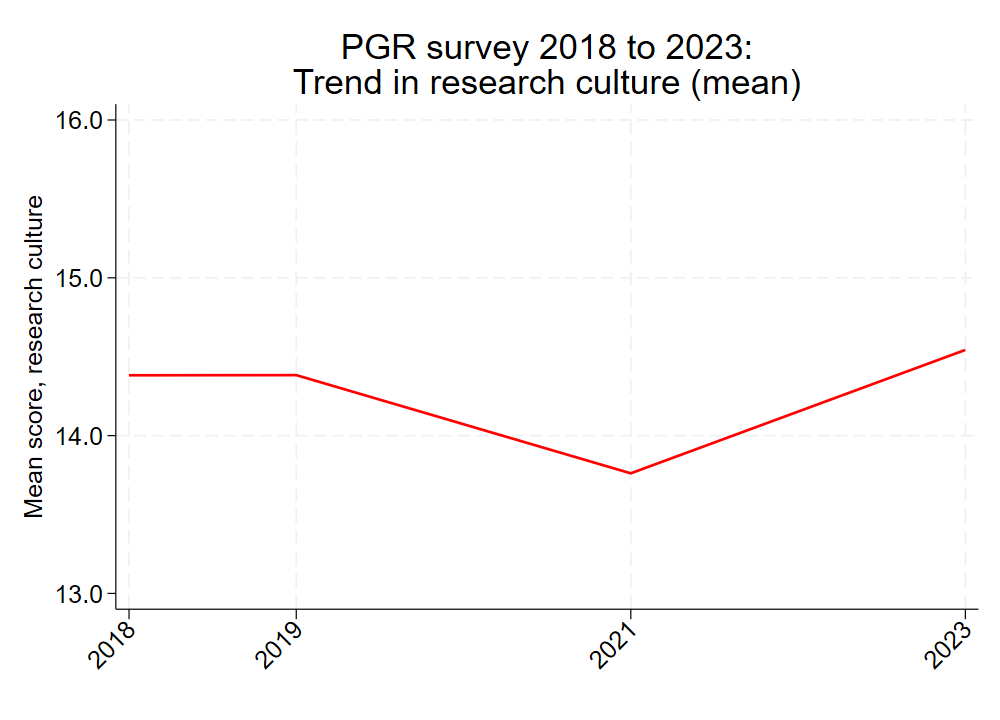
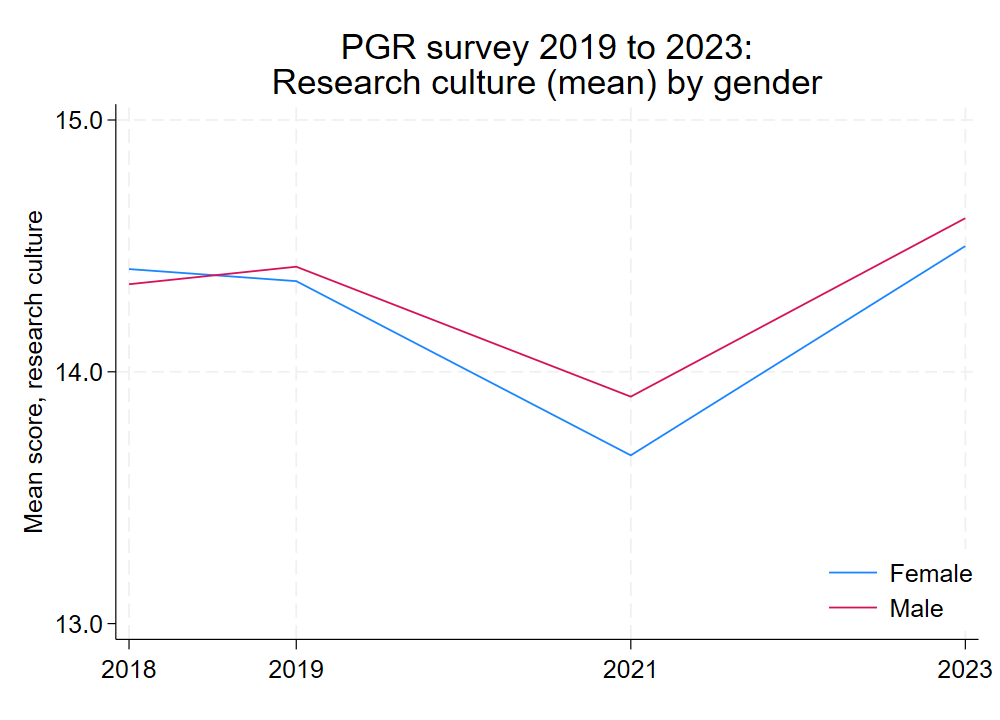
The overall trend in average research culture scores is one we have seen before: a dip at 2021 and then subsequent recovery in 2023. The decline to 2021, from 14.4 to 13.8 average points, was small relative to other measures we have analysed (see previous blog posts), while the 2023 mean score (14.5) was above the level of the pre-2021 dip, indicating a full recovery in scoring from that blip.
Gender
The scoring values and trend were quite similar for females and males. However, females declined by more in 2021, and their average scores continued to lag marginally below males in 2023. This is likely due to the higher proportion of females studying AHSS fields compared to STEM, and AHSS scoring in research culture were marginally lower than STEM. 2025 might see a closing of this gap if the trajectories continue.
Age
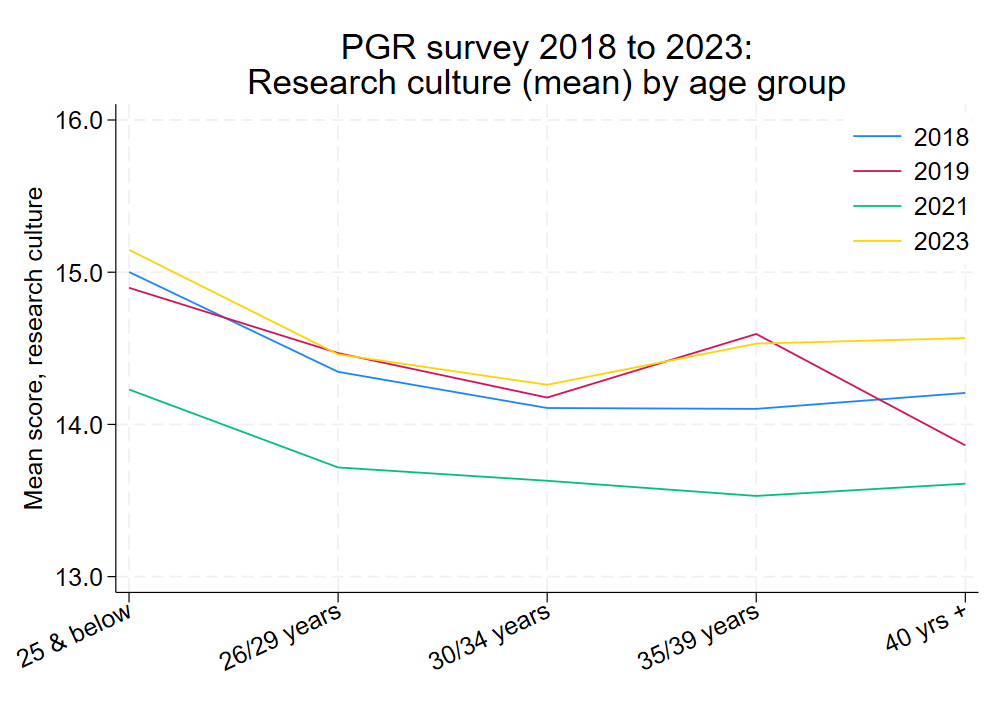
The youngest age group, 25 years and below, rated research culture higher on average than other age groups. The middle groups tend to see a flattening of the score, while the older groups had a marginal uptick. The exception to that was 2019, where scoring for the 40 years and older group was lower than the younger groups.
Institution type
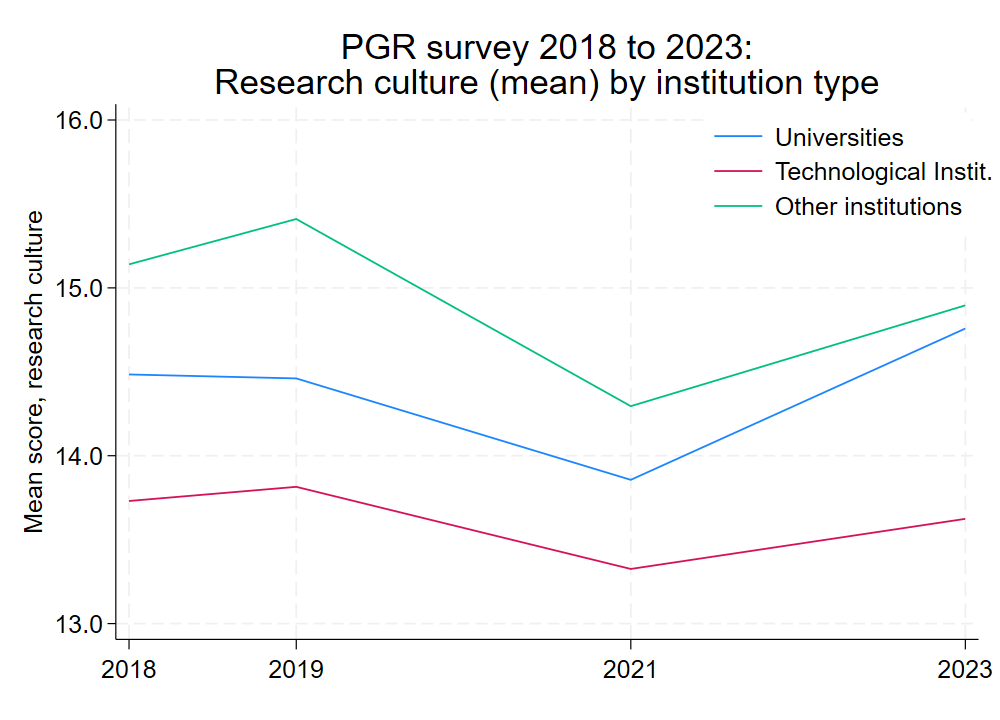
Technological HE institutions had lower average scoring in research culture than universities or other institutions. All three types declined from 2019 to 2021; Covid-19 and the associated restrictions are the most likely explanation for this. Universities bounced back subsequently so that 2023 was their highest average scoring year. For technological HE institutions, 2023 was lower than the 2019 level, and more than one point in mean scoring below universities at the latest survey. Mean scoring for other institutions was quite volatile. This arose from low frequency in this group, which will often result in “noisier” data.
Programme type
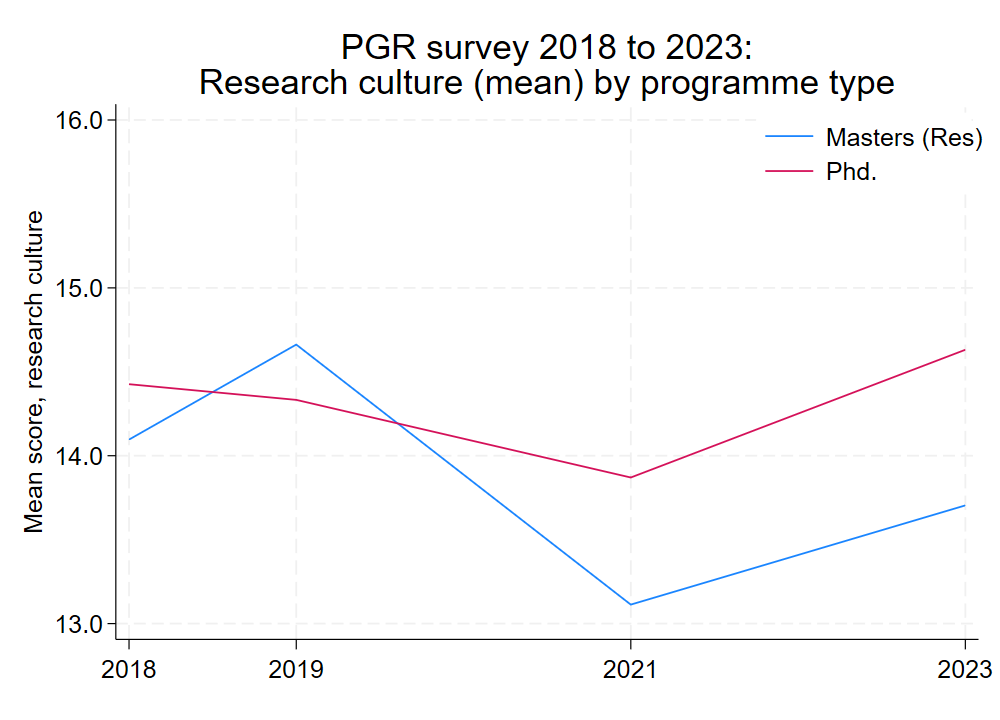
Mean scores between 2019 and 2021 went down for master’s by Research students by substantially more (1.5 points decline) than PhD. students (0.5 points decline). A possible explanation for this is that Covid-19 restrictions had a bigger detrimental effect on less experienced research students, particularly regarding opportunities to engage with other students and the wider research community. As we will see further down, earlier stage PhD. students fared worse in that year compared to those in at a later stage also. Master’s students had also not recovered the deficit in average scoring in 2023. 2025 data will be interesting to watch for research culture scores among master’s students.
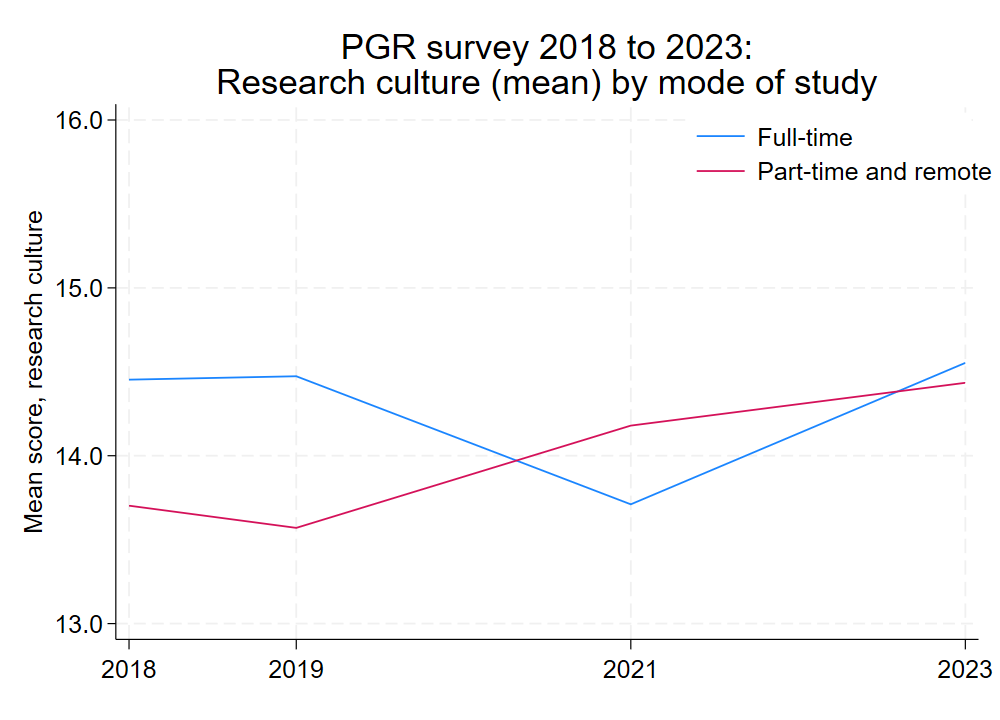
Mode of study
Contrasting patterns over time for the two modes. Full-time students scoring for research culture declined sharply between 2019 and 2021 and then rebounded in 2023, and that year was this groups’ highest level. Scoring for part-time and remote students increased between 2019 and 2021, and rose again in 2023. Despite the distinct patterns for the two sub-groups, average scoring was quite similar for the two in 2023. It’s difficult to predict what trajectories full-time and part-time students might see in research culture in the next set of data.
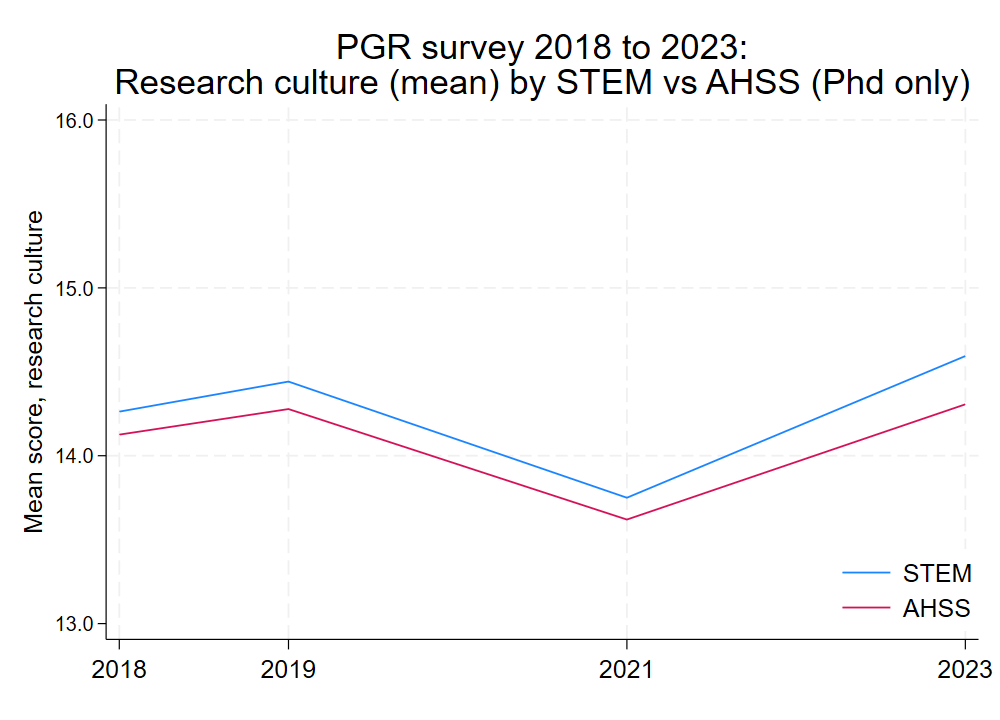
Field of study (PhD. only)
There was broadly similar mean scoring and pattern over time for PhD. students studying in STEM and AHSS, although STEM scoring was marginally but consistently higher. As noted under gender, the greater proportion of female students in AHSS and slightly lower mean scoring in this likely contributed to the small gender difference we saw in mean research culture scoring.
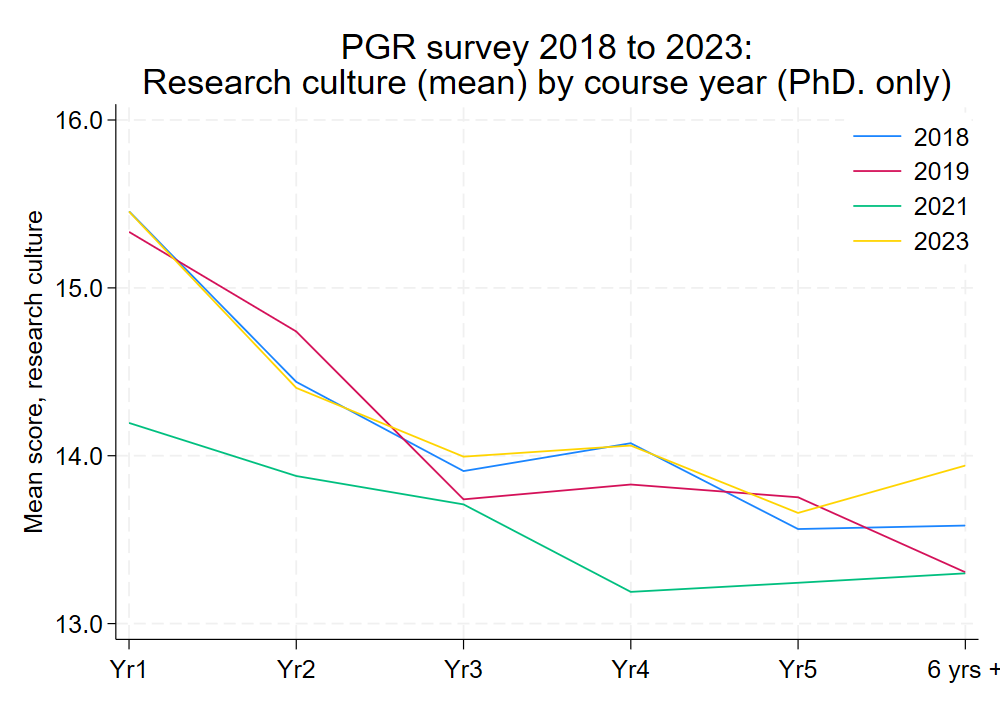
Course year
For PhD. students, there was a wide disparity in research culture scoring between those in course year one and two and all other years. Reflecting on the questions, this might be considered a surprising result. Access to opportunities to discuss their research might seem more likely for more experienced researchers, whereas we see a sharp decline in scoring for later course years. It may be that these questions are partly capturing an enthusiasm for their research among early course year graduate students. As we noted under programme type, master’s students compared to PhD. students had a larger drop in 2021, and we see the same between earlier and later phase PhD. students in that year. The same factor, a bigger negative effect of Covid-19 restrictions for earlier years, would be consistent with both findings.
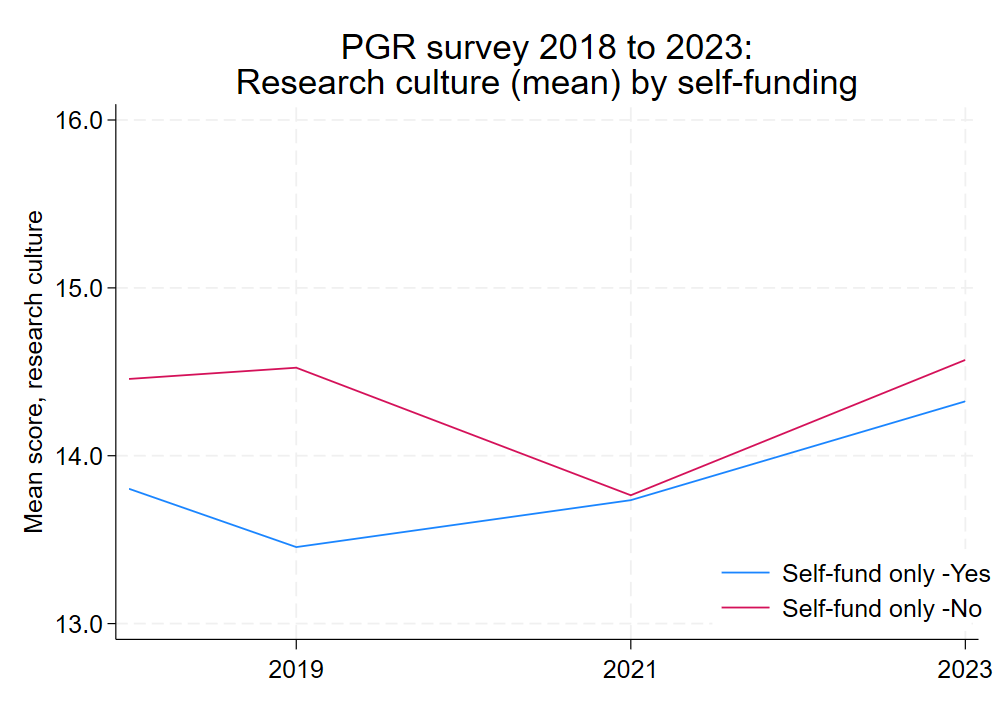
Self-funding
Self-funded research students tended to have higher scoring in research culture than those not solely self-funded, and the pattern over time differed between the two groups. For those self-funded, mean scoring declined in 2021, while for the group not exclusively self-funded, mean scoring increased which had the effect of almost equalising the scoring between the sub-groups in that year. The size of the difference between these two sub-groups was smaller in 2023 (0.3 points) compared to 2018 (0.7 points) and 2019 (1.0 points).
Confidence of completing PhD. on time
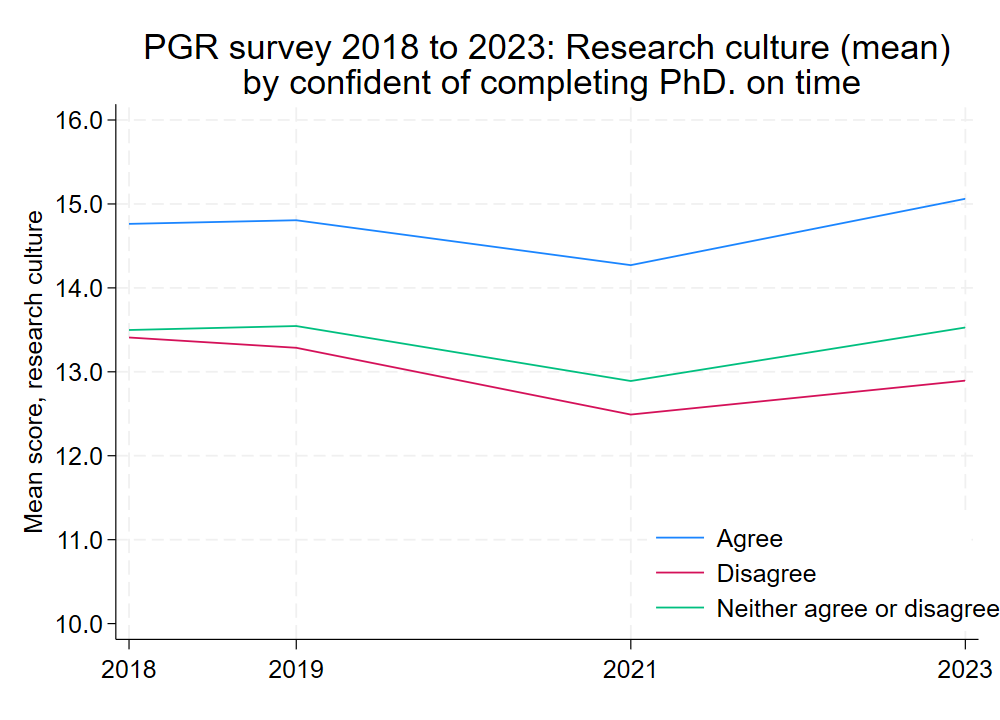
We also looked at whether there were differences among PhD. students' rating of research culture based on their confidence level of completing their programme on time. This question was a five-point scale, and we grouped those who report that they definitely or mostly agree they will complete on time as "agree", and those who definitely or mostly disagree were grouped as "disagree".
We found that those who agreed that they were confident of completing on time rated research culture consistently higher than those who disagree. The difference has grown over the observed period: in 2018, those who agree scored research culture 1.4 points higher on average than those who disagree, in 2021 it was 1.8 points gap, while in 2023 the difference was 2.2 points. Those who reported "Neither agree nor disagree" tended to score research culture in between those who reported agree and disagree, although more closely aligned to the latter.
Overall experience
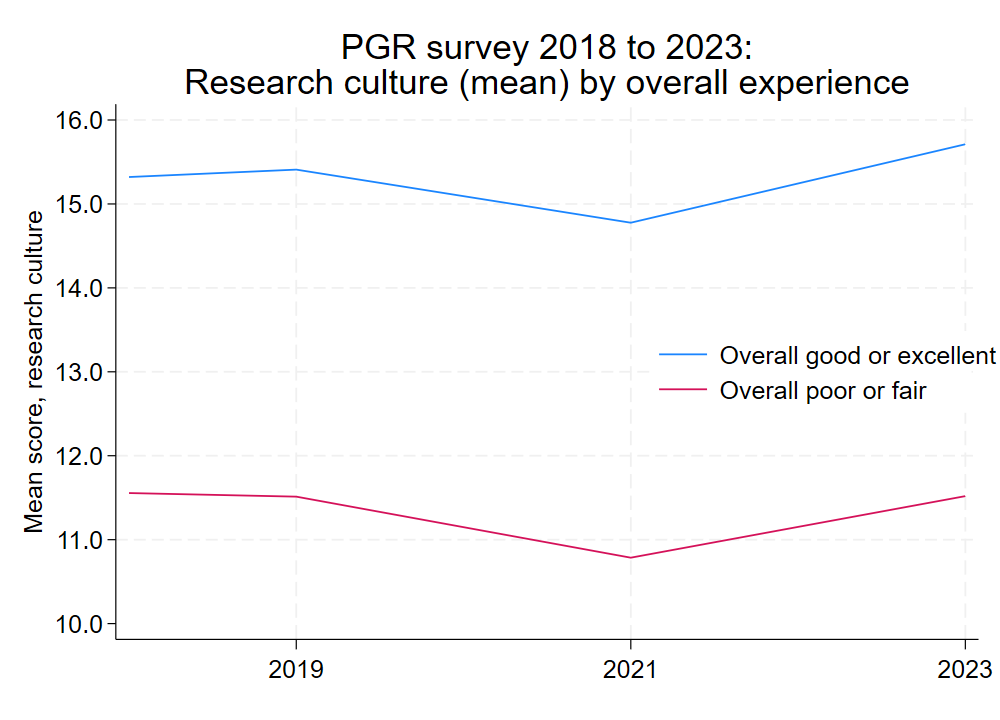
The average research culture scoring for those who rated the overall experience of their HEI as either good or excellent was much higher than those who rated their experience as either poor or fair. The difference is consistent from survey to survey, between 3.7 and 4.2 points, and equates to about one unit of standard deviation in research culture scoring for all participants. The wave to wave trajectories are broadly similar for the two sub-groups. Research students who tended to report higher research culture scores also tended to report a much more positive experience of the institution.
Summarising the analysis, younger and earlier phase graduate students rated research culture higher at their institutions, while students at universties and other institutions scored research culture higher than technological HE institutions. There is also a defined dip in scoring in 2021, likely Covid-19 related, but overall it is not a substantial drop and most sub-groups analysed had reverted to pre-2021 levels by 2023. However, this was not the case for master’s students and those attending technological HE institutions. There was a consistently strong association between high research culture scoring and positive assessment of graduate students’ overall experience of their HEI.
Look out for our final post in the series, which will focus on personal outlook.
We'd love to hear your feedback. Contact us at info@studentsurvey.ie, or follow us on social media:
https://www.facebook.com/StudentSurveyIE
X/Twitter
- https://x.com/StudentSurveyIE
@studentsurveyIE
- https://www.instagram.com/studentsurveyie
@studentsurveyie
- https://www.linkedin.com/company/studentsurveyie/
TikTok
- https://www.tiktok.com/@studentsurveyie
@studentsurveyie
Youtube
- https://youtube.com/@studentsurveyie4526?si=2s6-PywfHtnymJL_
-------------------------------------------------------------
*https://studentsurvey.ie/sites/default/files/Validity%20and%20Reliability%20testing/Reliability%20of%20the%20Irish%20Survey%20of%20Student%20Engagement%20for%20Postgraduate%20Research%20Students%202018.pdf